


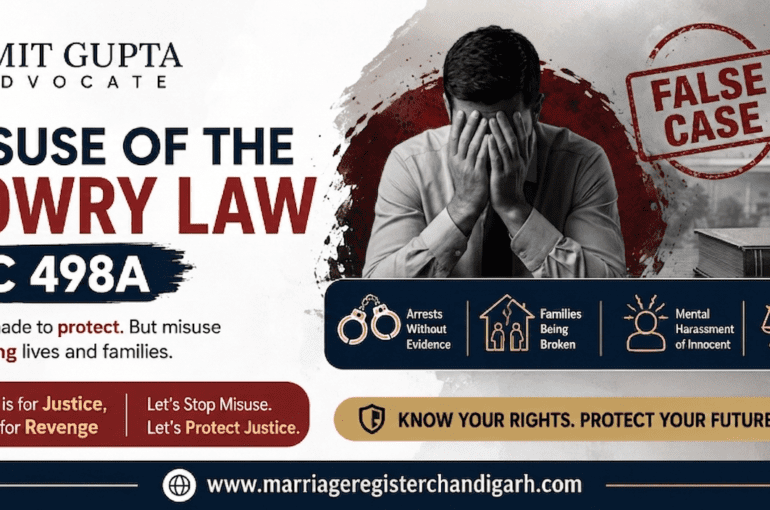
Misuse Of The Dowry Law IPC 498A
Misuse Of The Dowry Law IPC 498A- Every year thousands of cases are instituted in India under Section 498A IPC. According to NCRB data, 1.1 lakh+ cases were registered in a single year in India under dowry law. The conviction rate is less than 15% only. A wide gap between cases and conviction demands the question – Is the law being misused?
Sec 498A of IPC was added in 1983 for the protection of married women against dowry cruelty and harassment. It is one of the most effective laws in the context of matrimonial cases.
An arrest can happen without a warrant. Bail is difficult. And the case cannot be withdrawn privately.
But over the decades, this shield has often been used as a sword. False 498 cases are filed during divorce proceedings to pressure husbands and their families. Innocent parents, sisters, and relatives are named in FIRs without any proof.
In this blog, we break down how the misuse of the Dowry Law, IPC 498A, is happening, who gets affected, and what legal remedies are available.
What Is Section 498A IPC? Understanding the Dowry Law
Section 498 A law applies to the husband and his family members. It covers two types of cruelty, physical and mental. Physical cruelty means beating or causing bodily harm. Mental cruelty means harassment, threats, or emotional abuse. It also covers cases where a woman is harassed for bringing more dowry from her family.
This is a very powerful law. It is a cognizable, non-compoundable, and non-bailable offense. That means police can arrest without a warrant. Bail is not easy to get. And the case cannot be settled between the two parties privately.
Punishment under this act is a fine and three years’ imprisonment. The Indian government implemented BNS in 2023, and section 498A has been replaced with 85 BNS; the basic intent remains unchanged.
This law was put in place to protect women; however, over time, its misuse in India has become a significant issue.
Misuse of Section 498A IPC – A Growing Concern in India
Section 498A was made to help women. But today, it is often misused as a weapon.
Many cases are filed during divorce or separation. The wife files a false dowry case to pressure the husband and his family. This is one of the most common patterns of matrimonial disputes in India.
The biggest problem is vague allegations. Words like “cruelty” and “harassment” are broad. They are easy to allege but hard to disprove.
In many cases, entire families are named in the FIR. Aged parents, sisters, and distant relatives are accused. Often, no specific act is mentioned against them.
The NCRB data demonstrates a significantly low conviction rate under Section 498A. This clearly indicates that a huge majority of cases don’t have strong evidence.
Even the Supreme Court has expressed concern. It has called out the tendency to use this law for “personal vendetta.” In the 498A Supreme Court judgment of 2025, the Court quashed cases where allegations were vague and unsupported.
NRI husbands face an even bigger risk. Their passports can be impounded. They can be trapped in India during legal proceedings. This law needs to be used responsibly, not as a tool to take revenge from your partner.
Who Gets Falsely Accused Under Section 498A?
When a false dowry case is filed, it not only targets the husband; an entire family gets dragged in the case. Here is who gets accused most often:
- Husband – He is the primary target. Even minor arguments are presented as cruelty.
- Senior citizen Parents-in-Laws- Name of old, retired parents-in-law appear in the FIR, but generally, they do not live with the couple.
- Brothers-in-Law & Sisters-in-Laws- Name some FIRs with generic allegations, no dates, or incidents. No proof, only name.
- Distant family members- Aunts, uncles’, and cousins’ names have been noted.
- NRI Husbands – They face extra risk. Their passport can be impounded. They can be stuck in India for years.
The Supreme Court has clearly stated that naming relatives without specific acts leads to wrongful arrest. This is a growing concern in 498A cases. Vague allegations against multiple people are not acceptable in court.
Can a Husband File a Counter Case Against False 498A?
Yes. The husband is not helpless in false dowry cases. He can use legal mechanisms to defend himself. Here are the legal remedies for him:
- Section 182 IPC – Here, it is the wife who falsely misinformed the police. It is a direct opposite to the falsely filed FIR.
- 211 IPC – If there is malicious filing of a false criminal charge against anyone to harm him.
- Defamation Case – The husband may file a defamation suit against the wife under Sections 499/500 IPC for defaming his character by making false claims.
- Malicious Prosecution – This is a civil remedy. It can be used to claim compensation for mental and financial suffering.
- Section 9 HMA– Restitution of Conjugal Rights can be filed if the wife left without a valid reason.
One important warning, do not file a counter case out of anger. File it only when you have clear proof of false allegations. Always consult an experienced lawyer first.
Reforms Suggested to Prevent Misuse of Section 498A
There have been a number of proposed reforms from various law experts, judges, and committees to curb the misuse of the Act.
- Arnesh Kumar Guidelines (2014) – Police will be compelled to adhere to the checklist before making an arrest under section 498A. It should not be an automatic process.
- Malimath Committee (2003) – This committee was of the view that the offense under 498A should be made compoundable (parties be allowed to come to a mutual settlement).
- Gender Neutral Law- Most of the people are of the opinion that cruelty laws should also apply to men along with women. Women are now only covered under these laws.
- A pre-arrest inquiry must be made- Police must inquire and then register an FIR and should arrest only if there is nothing else left to do, and arrest shouldn’t be the first action.
- BNS 2023- India has seen a new criminal code, but this does not properly address the misuse of 498A.
The 2025 Supreme Court judgment of 498A is consistent in asking for a balanced approach. Victims deserve justice, but innocent families should not be made to face false cases.
How to Defend Yourself in a False Section 498A Case
Yes, it is definitely scary to handle a false 498A case. But if you keep your cool and make the right choices, you can ease down your worries. Follow the below steps to get things working in your favor.
- See an advocate in time- Don’t delay. Visit an experienced criminal advocate as soon as possible.
- File for anticipatory bail in 498A- This will save you from getting arrested on the spot. File this as early as possible.
- Keep records of Evidence- Save all WhatsApp messages, call recordings, bank statements, photographs, etc. This would prove you are not guilty.
- File Quashing Petition- If the complaint is baseless and vague in nature, your lawyer can file a 498A quashing petition in the High Court to quash the FIR.
- Attempt mediation- There are many times that a quick agreement out of court is less of an expense to your time, money, and sanity.
- Mistakes to avoid- Do not attempt to contact the complainant directly. Do not post on social media about the accusation. Do not miss any court dates.
The acquittal rate in 498A cases is very high. A false case can be fought with the right kind of lawyer and good evidence.
Conclusion
Section 498A is indeed a much-needed law that does safeguard the real dowry victims. However, misuse of this dowry law has caused immense harassment of thousands of innocent families across India. And removal of the law is not the remedy; the misuse of this law can only be tackled by sensible usage of it. The actual dowry victims need to be justly compensated, and the innocent family from wrongful allegations has to be protected as well.