

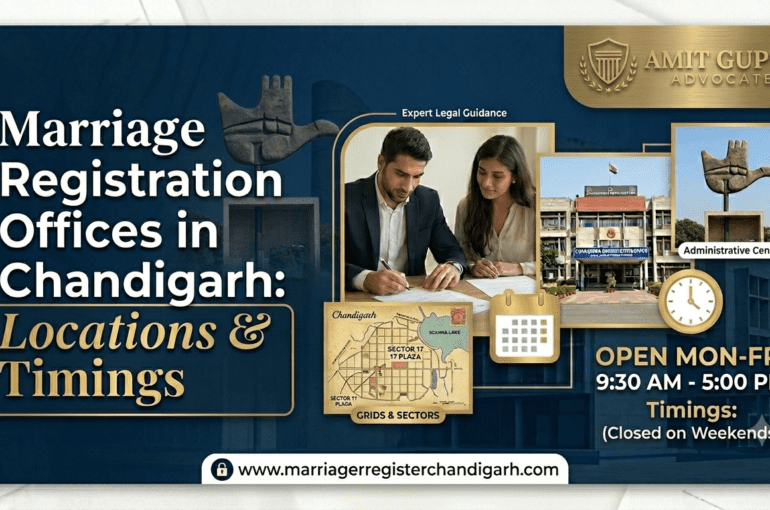
Marriage Registration Offices in Chandigarh: Locations & Timings
Marriage Registration Offices in Chandigarh: Locations and Hours – In Chandigarh, registering a marriage has legal implications; it helps to recognize your marriage under Indian law and provides legal recognition. The registration process provides transparency and offers legal assurance before the law. In Chandigarh, marriage registration is handled systematically and transparently through Marriage Registration Offices.
Marriage registration offices in Chandigarh are run by subdivisional magistrates (SDM) and municipal corporations. Each of these organizations has its own jurisdiction and workforce and adheres to applicable laws. Therefore, whether you are planning a court marriage or a traditional one in Chandigarh, being aware of the exact location and working hours of the offices serves a crucial role. Knowing precisely when and where to go can help couples avoid delays and finish this crucial process quickly, even though it might seem like a small detail.
Navigating this process could be cumbersome. Therefore, Advocate Amit Gupta presents a detailed list covering different Marriage Registration Offices in Chandigarh, informing of the exact address, location, working hours, and types of registration each office performs.
Why Does Accurate Information About Marriage Registration Offices Matter?
Registering your marriage is a legal process that involves Spouses, witnesses, and the marriage registrar’s office. Knowing the exact Location and timings makes a significant difference in how smoothly and efficiently your registration process unfolds. Also, it avoids unnecessary delays, repeated visits, and last-minute confusion. In Chandigarh, marriage registration is handled by the Sub-Registrar Offices under the supervision of the Sub-Divisional Magistrate.
The procedure of registering a marriage involves various steps, documentation, witnesses, ensuring both partners are available, and a Magistrate. Knowing accurate timings and locations helps you be ahead of the plan and meet all legal deadlines. Also, Witnesses are a crucial part of the process, and their availability is often limited. This makes it simpler to synchronize everyone’s arrival, ensuring the process runs smoothly without unnecessary delays or the need to reschedule.
Advantages of Being Aware of Marriage Registration Office Availability
In Chandigarh, government offices follow strict working hours and may operate on specific days for certain services. So, being informed about the exact location and Timings helps you avoid unnecessary delays, mistakes, and confusion. Coordination between two partners, two to three witnesses, and a government registrar is all necessary for the registration process, which goes beyond simply presenting documentation. They must all be present at the same time on the same working day.
Here’s a list of key benefits of knowing the locations and schedules beforehand, mentioned as follows:
You Avoid Wasteful Trips to the Wrong Offices
Chandigarh has multiple marriage registration offices, each working on a different jurisdiction process. SDM offices handle registration cases under the Special Marriage Act, and Municipal Corporation offices handle cases under the Hindu Marriage Act. Moreover, arriving at the wrong place affects the progress of all the registration processes.
Ensures Compliance with Deadlines
Under the Special Marriage Act, 1954, there’s a 30-day notice period before legally registering the marriage. If you miss an appointment or arrive late, it may extend the waiting time unnecessarily.
You Reduce the Risk of Document Rejection
Different offices require different documents, depending on the marriage act under which you are operating the registration. Being aware of these documents avoids last-minute delays.
Saves for Witnesses Time
Witnesses play a crucial role while registering the process, but their availability is often limited. If you are aware of the locations, it helps coordinate well and makes it easier for everyone, avoiding delays and confusion.
You Avoid Peak Hour Delays
The Sector 17 offices, in particular, witness heavy footfall between 11 AM and 1 PM. Try to arrive at opening time (usually 9:30 to 10:00 AM) to minimise your waiting time and maximise the chance of getting same-day processing.
Overview: List of Marriage Registration Offices in Chandigarh
Marriage Registration Offices has its own jurisdiction, working hours, and procedures, so being aware of the right location helps to avoid unnecessary delays, mistakes and waste of time. Whether it’s a court marriage or a registration under the HMA or SMA, having a specific idea about the nearest and most reliable office makes the process smoother.
A list of various Marriage Registration Offices in Chandigarh, including their locations, Working hours, days and descriptions, enabling people to plan their visit accordingly, has been mentioned above.
| S. No. | Office Name | Jurisdiction / Act | Address | Working Hours | Lunch Break |
|---|---|---|---|---|---|
| 1. | SDM Office, Sector 17-C | Special Marriage Act | Near Parade Ground, Sector 17-C, Chandigarh – 160017 | 9:30 AM – 5:00 PM | 1:30 PM – 2:00 PM |
| 2. | District Court Complex, Sector 17 | Both Acts | District Court Complex, Sector 17, Chandigarh – 160017 | 10:00 AM – 5:00 PM | 1:00 PM – 2:00 PM |
| 3. | MCC Marriage Registration Office, Sector 17-E | Hindu Marriage Act | Municipal Corporation Building, Sector 17-E, Chandigarh – 160017 | 10:00 AM – 5:00 PM | 1:00 PM – 1:30 PM |
| 4. | Civil Registration Office, Sector 17 | Civil Registration | Civil Registration Office, Sector 17, Chandigarh – 160017 | 10:00 AM – 4:30 PM | 1:00 PM – 1:30 PM |
| 5. | Additional Registration Office, Sector 46-C | Hindu Marriage Act | Government Office Complex, Sector 46-C, Chandigarh – 160047 | 10:00 AM – 4:00 PM | 1:00 PM – 1:30 PM |
| 6. | SDM Office, Phase 3B2, Mohali | Both Acts | SAS Nagar (Mohali) – 160059 | 9:30 AM – 5:00 PM | 1:30 PM – 2:00 PM |
Required Documents Checklist for Marriage Registration in Chandigarh
Preparing the correct documents is an essential part of marriage registration, as even a minor mismatch or missing proof can delay or reject the application. Chandigarh authorities follow a strict documentation process under the Hindu Marriage Act or the Special Marriage Act, depending on the couple’s situation.
Having all documents arranged, self-attested, and verified ahead of time ensures a smooth, stress-free process.
Common Documents (Both Partners)
| Document Type | Accepted Proofs | Notes |
|---|---|---|
| Identity Proof | Aadhaar Card, Passport, Voter ID, PAN Card | Must be government-issued with photo |
| Age Proof | Birth Certificate, Class 10th Marksheet, Passport | Must confirm minimum age: 21 for groom, 18 for bride |
| Address Proof | Aadhaar Card, Passport, Rent Agreement, Utility Bill | The address must fall within the office’s jurisdiction |
| Passport-size Photos | 6–10 recent passport-size photographs each | White background preferred |
| Affidavit | Notarised affidavit on stamp paper | States marital status, nationality, date of birth, and place of residence |
Hindu Marriage Act (HMA) — Additional Documents
| Document | Details |
|---|---|
| Wedding Invitation Card | Original card from the marriage ceremony |
| Joint Wedding Photographs | 4–6 photos of both partners taken during the ceremony |
| Priest/Pandit Certificate | Signed confirmation of the religious ceremony (some offices require this) |
| Self-Attested Photocopies | One set of all documents listed above |
Special Marriage Act (SMA) — Additional Documents
| Document | Details |
|---|---|
| Notice of Intended Marriage | Form filled at the SDM office – must be submitted 30 days before the registration date |
| Proof of Single Status | Affidavit confirming neither partner is currently married |
| Witness Documents | Aadhaar/PAN/ Passport of 2 witnesses – must be present in person on registration day |
| No Objection Certificate | Required if either partner was previously married and divorced |
| Divorce Decree / Death Certificate | Mandatory if either partner is divorced or widowed |
NRI / Foreign Spouse — Additional Documents
| Document | Details |
|---|---|
| Valid Passport | Of the foreign or NRI spouse – must be valid at the time of registration |
| Valid Visa | Tourist, spouse, or long-term visa – copy required |
| OCI / PIO Card | If applicable |
| Embassy Affidavit | Confirming single/unmarried status – must be attested by the Indian Embassy in the country of residence |
| No Objection from Embassy | Some nationalities require an NOC from their home country’s embassy |
Step-by-Step Marriage Registration Process in Chandigarh
Understanding the registration process helps couples navigate legal procedures confidently and avoid confusion during appointments. The process varies depending on the act under which the marriage is being registered. Here is a step-by-step procedure to be followed while registering for marriage under
Process A – Hindu Marriage Act, 1955
It is applicable for Hindu, Buddhist, Jain, and Sikh couples whose marriage has already been solemnized.
Step 1- Get your jurisdiction confirmed:
Visit the Municipal Corporation or SDM office that corresponds to your address. Ideally, the address of both partners should fall under the same jurisdiction, but in case it does not, then the registration takes place in the office relating to the husband’s address.
Step 2 – Ready your documents:
Get all the required documents, as mentioned above in the checklist. Get each of these documents self-attested and ask 2-3 witnesses for their availability for the date of registration. Have a photocopy of the application forms and other necessary documents.
Step 3 – Get the application form filled:
Get the marriage registration form from the concerned office or download it from the website of the Chandigarh Administration, i.e., chandigarh.gov.in. Make sure the form is filled out carefully with the proper name and date of birth, as a wrong name or date of birth is one of the most common reasons for rejection.
Step 4 – Visit the office together:
The parties, along with all witnesses, should be present before the registrar in the Municipal Corporation Office. Make sure to carry all the original documents and self-attested copies.
Step 5 – Registrar to verify papers
The documents submitted to the registrar shall be checked, and in case they all appear correct, the registrar shall proceed with recording the marriage registration in the register. In case the documents are found deficient, they shall not be re-checked at the office; instead, the couple will be allotted a fresh date for registration.
Step 6- Sign the register:
After the registrar is satisfied that all the conditions have been duly complied with, both partners, along with the witnesses, sign the official register.
Step 7- Obtain your certificate of marriage:
A certificate of marriage shall be issued after completion of the recording by the registrar. Under the Hindu Marriage Act, a certificate of marriage is usually issued on the same day but at times may take 2-3 working days depending on the situation. The certificate issued is a printed, signed and stamped document.
Process B — Special Marriage Act, 1954
It is applicable for couples of different religions, NRIs, inter-state couples, or those preferring a civil registration.
Step 1 – Notice of Intended Marriage Submission
Visit the SDM office; both partners must be present. The “Notice of Intended Marriage” form should be submitted with simple identity and address proof documents. This notice is then published in the office for a period of 30 calendar days. Any person can make objections against the proposed marriage.
Step 2 – Objection period of 30 days
During this period, if any person objects to the proposed marriage, such objections shall be considered by the SDM. In case no objection is filed against the notice, it shall automatically be considered approved for the marriage registration.
In case of any objection raised by the person, the same shall be inquired into by the SDM, and an order shall be passed, and the registration shall be postponed for 30 to 90 days, depending on the nature and investigation.
Step 3 – Confirming registration appointment
Once the objection period of 30 days has passed with no opposition, or if any objection made is dismissed after the inquiry, confirm your appointment for the marriage registration at the SDM office.
Step 4 – Appearance before the Marriage Officer
You, your partner, and the two witnesses will appear before the Marriage Officer (SDM). All four of you would have to sign a declaration that you and your partner have entered into marriage voluntarily, are at least 18 years of age, and are not currently married.
Step 5 – Signature on the Marriage Register
Both partners, along with the witnesses, would then have to sign the Marriage Register. It is at this time that the marriage is officially registered under SMA.
Step 6 – Obtaining the Marriage Certificate
The marriage certificate under SMA is generally provided on the same day of the registration. It includes the Marriage Officer’s signature and the government seal, and it is valid across all states and even internationally.
Conclusion
Being aware of office location, working hours, required documents, and any prior appointment procedures ensures a hassle-free experience. It avoids the unwanted and unnecessary delays and mistakes and plays a significant and crucial role in the marriage registration process. There are various Marriage Registration Offices spread across Chandigarh; couples can plan their visit efficiently.